Protected vs Non-Protected Consumers: The 2026 Guide
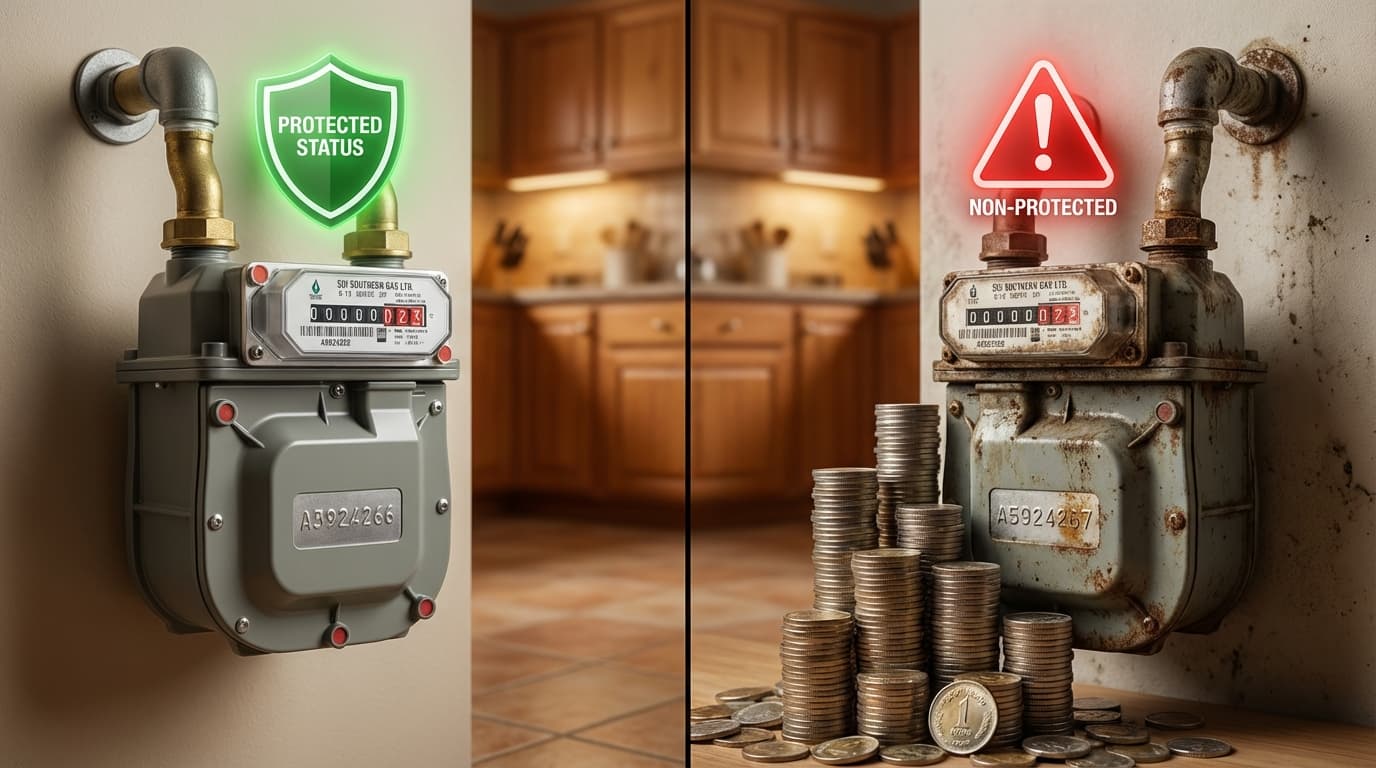
If you have compared gas bills with your neighbors recently, you might have noticed something shocking. One house pays Rs. 800, while the house next door with similar usage pays Rs. 4,000. Why? It all comes down to one label on your bill: "Protected" or "Non-Protected".
Do you know your current status?
Don't wait for the paper bill. Use our free tool to check your status instantly based on your meter reading.
Check Status with Calculator →The Golden Rule: 0.9 hm³
The Oil and Gas Regulatory Authority (OGRA) has set a strict threshold to define a "poor" or "middle-class" household. That threshold is 0.9 Hectometers (hm³).
In simpler terms, if your gas meter shows a consumption of roughly 90 Units (approx) or less per month, you are considered a low-consumption user. If you cross this line, the government assumes you can afford to pay premium rates.
The "Winter Lock" Mechanism
This is the part most people misunderstand. You don't become "Non-Protected" just because you used too much gas in June.
SNGPL and SSGC evaluate your performance only once a year. They look at your average consumption during the 4 winter months:
- November
- December
- January
- February
If your average usage across these 4 months is below 0.9 hm³, you earn the "Protected" badge for the entire year. If your average exceeds it, you are locked as "Non-Protected" for the whole year—even in summer when you barely use gas.
Price Difference: Why it Matters
The cost difference isn't small; it is massive. Being Non-Protected doesn't just mean paying a little extra tax. It completely changes your tariff slab.
| Feature | Protected | Non-Protected |
|---|---|---|
| Gas Rate (Cost per Unit) | Subsidized (Rs. 200 - 350) | Expensive (Rs. 500 - 4,200) |
| Fixed Monthly Charge | Rs. 600 | Rs. 1,500 or Rs. 3,000 |
As you can see, a Non-Protected user pays nearly 3x to 5x more for the same amount of gas, plus a massive fixed monthly fee. This is the exact reason why your gas bill remains incredibly high in the summer even with zero usage.
How to regain Protected Status?
If you are currently Non-Protected, you cannot change it right now. You have to wait for the next winter cycle.
The Strategy: During next November, December, January, and February, you must aggressively control your gas usage. Use electric heaters instead of gas, turn off geysers during the day, and ensure your total consumption stays under 90 units per month. If you succeed, your status will revert to Protected in March.
Frequently Asked Questions (FAQs)
How many units is 0.9 hm³?
0.9 Hectometers (hm³) is roughly equivalent to 90 to 100 Units (or MMBTU) on your gas meter, depending on the Gas Calorific Value (GCV) of your specific region. To be safe, aim to keep your monthly meter reading difference below 90 units.
If I save gas in March, will I become Protected?
No. SNGPL and SSGC only review your status based on the Winter months (Nov to Feb). Saving gas in March or April will lower your current bill amount, but it will not change your "Non-Protected" category or reduce your fixed monthly charges until the next review cycle next year.
Does this apply to both SNGPL and SSGC?
Yes. The tariff structure is decided by OGRA (Federal Government) and applies to both Sui Northern (Punjab/KPK) and Sui Southern (Sindh/Balochistan). The fixed charges and slab rates are identical for domestic consumers across Pakistan.
How do I check if I am currently Protected?
Look at your latest gas bill. On the top left or right corner (depending on the company), there is a box labeled "Consumer Category" or "Tariff". It will explicitly state "Domestic Protected" or "Domestic Non-Protected". Alternatively, use our Bill Calculator to test your usage.